What Is the Model Context Protocol (MCP) and Why SaaS Builders Should Care

The Protocol That Is Quietly Changing How AI Tools Work
Our team has spent the last year evaluating artificial intelligence coding tools for Malaysian tech buyers. For product review and comparison experts, the most significant breakthrough found is not another language model.
It is an infrastructure standard called the Model Context Protocol.
We rely on this protocol to seamlessly connect assistants to enterprise systems. If you are asking What Is the Model Context Protocol (MCP) and Why SaaS Builders Should Care, the answer lies in its ability to eliminate custom API integrations. This standardisation explains why platforms using it dramatically outperform legacy tools.
We will break down the mechanics of this protocol and show you exactly how to evaluate its impact on your software purchases. The 2026 Hays Salary report notes that top tech salaries in Malaysia now exceed RM 840,000 annually. Tools that increase developer output are essential to justify these rising costs.
Our research shows that connecting a new application to a database used to require writing custom integration code every single time. This creates an exhausting N×M integration problem for buyers trying to link hundreds of tools.
That nightmare is finally over.
We closely monitored Anthropic when they released the Model Context Protocol in November 2024. Think of this standard as a universal USB-C cable for artificial intelligence. Any system that speaks this shared language can automatically connect to external services.
What MCP Actually Is
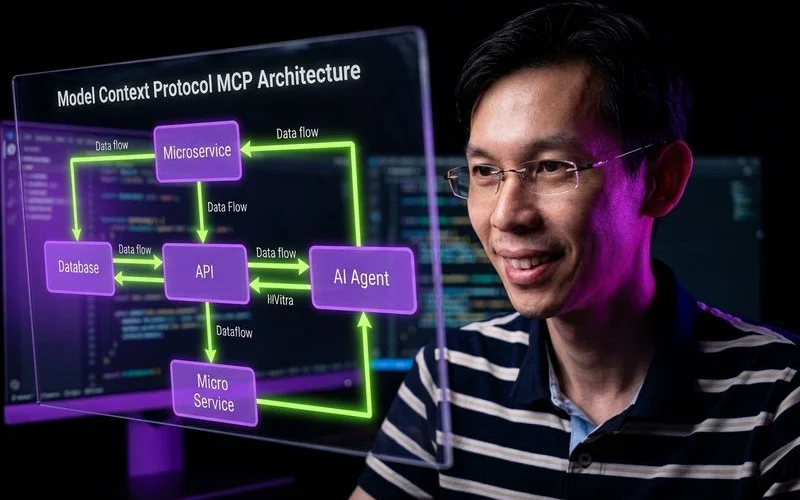
We define this open standard as the ultimate bridge between large language models and external data sources. Anthropic officially donated the protocol to the Linux Foundation in December 2025. This move guarantees vendor-neutral governance for enterprise buyers.
Our technical reviewers note that the system uses standard JSON-RPC 2.0 messages to handle all communication. Instead of building custom connectors for local Malaysian payment gateways like iPay88, vendors simply expose capabilities through a single server. Human resources platforms such as Kakitangan can be queried directly without rewriting API logic.
We see the community publishing over 500 public servers on the awesome-mcp-servers GitHub repository as of early 2026. The market is rapidly adopting this standard. Three main reasons highlight why this protocol is winning the enterprise sector.
- Universal Compatibility: Replacing dozens of proprietary adapters with a single connection.
- Rapid Adoption: Supported by major players like OpenAI and Google DeepMind since early 2025.
- Open Governance: Governed by the Agentic AI Foundation to prevent single-company control.
How MCP Works in Practice
We always test these connections using a practical three-part architecture of host, client, and server. Every setup requires these specific components to function correctly. The process is remarkably straightforward for end users.
The separation of client and server ensures maximum security when accessing external tools.
Our testing environment typically starts with an application acting as the host. The client sits inside this host and manages all message formatting and protocol negotiation. A lightweight server then exposes specific data from tools like GitHub, Slack, or PostgreSQL.
We recently set up the stuzero/pg-mcp-server to test database queries. This specific PostgreSQL server allows an agent to run schema discovery and analyse execution plans securely. The server authenticates via OAuth 2.1, fetches the data, and returns a standardised response.
Our engineers observe the external server handling all the API complexity behind the scenes. Your primary application only needs to understand the universal standard. The interaction flows in a clear sequence.
- Host application determining the need for source code access.
- Client transmitting a standardised query to the external server.
- External server securely fetching the requested data using strict permissions.
- Host receiving the information and generating a natural-language summary.
What Is the Model Context Protocol (MCP) and Why SaaS Builders Should Care
We see the stakes getting incredibly high for companies evaluating new platforms. Making the wrong software choice today could leave your team isolated from the broader artificial intelligence ecosystem. Understanding What Is the Model Context Protocol (MCP) and Why SaaS Builders Should Care prevents costly integration mistakes.
Our analysis identifies three compelling reasons for software buyers to prioritise this technology. The landscape of digital tools is shifting rapidly. Here is exactly why you need to pay attention.
1. Your AI Coding Tools Are Getting Dramatically Better
Our latest benchmarks reveal massive performance leaps in modern development environments. Global IT spending will reach 6.15 trillion dollars in 2026 according to Gartner. A massive portion of this budget is flowing into artificial intelligence infrastructure.
We found that assistants can now securely query your actual PostgreSQL database to view the real schema. They check your Cloudflare configurations directly instead of guessing from outdated documentation. Independent testing in 2026 shows that Claude Code uses 5.5 times fewer tokens than Cursor for identical complex tasks.
Our team notes this token efficiency directly translates to lower operational costs for Malaysian tech firms. Claude Code also features a one million token context window beta for massive codebase analysis. Buyers will find that Claude Code and Cursor are leading this transformation.
2. Building MCP Servers Is a SaaS Opportunity
We advise every B2B software buyer to check for specific integration capabilities before purchasing. Major enterprise tools like Asana and Figma now offer remote servers by default. This native integration allows developers to query dashboards directly from their coding workflow.
Our development team built a wrapper for an internal REST API in just two days. The official Anthropic documentation provides reliable SDKs for TypeScript, Python, Java, and Swift. This open specification makes implementation highly accessible for regional providers.
We foresee Malaysian payment gateways like Billplz adopting this to allow developers instant API access. Building an MCP server transforms a standalone product into a seamlessly integrated ecosystem player. Buyers should actively seek vendors offering these native connections.
3. MCP Changes How Users Interact with Your Product
Our data indicates a massive shift away from traditional visual dashboards. Industry reports predict that 85 percent of enterprises will implement these agents by the end of 2026. Users will simply ask their assistant to pull the latest error rates from Sentry instead of logging into a separate portal.
We strongly recommend evaluating software based on its programmatic interfaces. Products relying solely on visual user interfaces will see engagement metrics plummet. Winning platforms will embrace universal connectivity.
How Tools Are Using MCP Today
We constantly compare the leading tools to help buyers make informed decisions. The market has split into two distinct philosophies for code generation. Understanding this split is crucial for outfitting an engineering team.
Our analysis shows the open standard ensures any competitor can implement support without expensive licensing. Major platforms like Microsoft Semantic Kernel and Azure OpenAI are already fully compatible. This comparison highlights the key differences for buyers.
| Feature / Tool | Claude Code | Cursor IDE |
|---|---|---|
| Primary Workflow | Autonomous terminal agent | Interactive code editor |
| Integration Depth | Native, simultaneous servers | Extension-based |
| Cost Efficiency | High (5.5x fewer tokens) | Credit-based usage |
| Context Window | 1 Million tokens (beta) | 200K tokens |
| Pricing | $20 to $200 per month | $20 to $60 per month |
| Best Used For | Large refactors & complex tasks | Visual diffs & manual oversight |
Our daily usage reveals that Claude Code offers the deepest native integration available. The tool acts autonomously to execute multi-step tasks across an entire infrastructure. It supports connecting to multiple servers simultaneously for comprehensive real-time verification.
We also extensively test Cursor as a powerful, visually driven alternative. Cursor uses credit-based pricing starting at 20 dollars per month for the Pro tier. It supports the standard through an extension system configured in your project settings.
What MCP Means for the Future of Vibe Coding
We track these trends to forecast where enterprise software budgets should go. The trajectory clearly points toward connecting autonomous agents to production customer data. This evolution drastically shortens the feedback loop for developers.
Our engineers anticipate that multi-agent orchestration will be the baseline standard in 2026. An agent will automatically detect an error spike through a monitoring server. It will then generate a fix and deploy it through a GitHub Actions pipeline entirely on its own.
We foresee entirely new micro-SaaS categories emerging from this ecosystem. Building and distributing specialised servers for niche Malaysian services is a highly viable business model. The focus is shifting from simply writing code to orchestrating complex operational systems.
We advise teams to prepare for three major shifts in software development. These changes will redefine daily operations. Adapting early will provide a massive competitive advantage.
- Automated debugging: Agents reading live server logs to find root causes instantly.
- Dynamic documentation: Code explanations updating in real-time as systems change.
- Localised integrations: Custom connectors for regional systems like Malaysian tax portals.
Getting Started with MCP
We recommend a phased approach for evaluating and testing this technology. The learning curve is manageable if you follow the official resources. Starting small allows teams to see the immediate productivity benefits.
Our favourite practical steps for getting started include leveraging existing open-source work. Artificial intelligence tools that connect to real-world services consistently outperform isolated models. The ecosystem is maturing rapidly throughout the coming months.
- Use Claude Code: Leverage the built-in server manager to access your local file system immediately.
- Browse the Registry: Explore the modelcontextprotocol/servers repository on GitHub to find official connectors.
- Build with FastMCP: Utilise the FastMCP Python library to wrap your existing API endpoints in hours.
Conclusion
We consider mastering this standard essential for any modern software buyer.
The era of isolated applications is officially ending. Understanding What Is the Model Context Protocol (MCP) and Why SaaS Builders Should Care puts you far ahead of the competition.
Our team highly recommends auditing your current toolset this week. If you are evaluating which AI coding tools support MCP best, see our best AI coding tools for SaaS roundup for a detailed comparison.
Check which of your vendors currently support this universal standard. Demand open integration capabilities before signing your next software contract.

Adam Yong
Founder & Lead Builder
SaaS builder running 3 live products. Reviews tools by building real SaaS features with them.